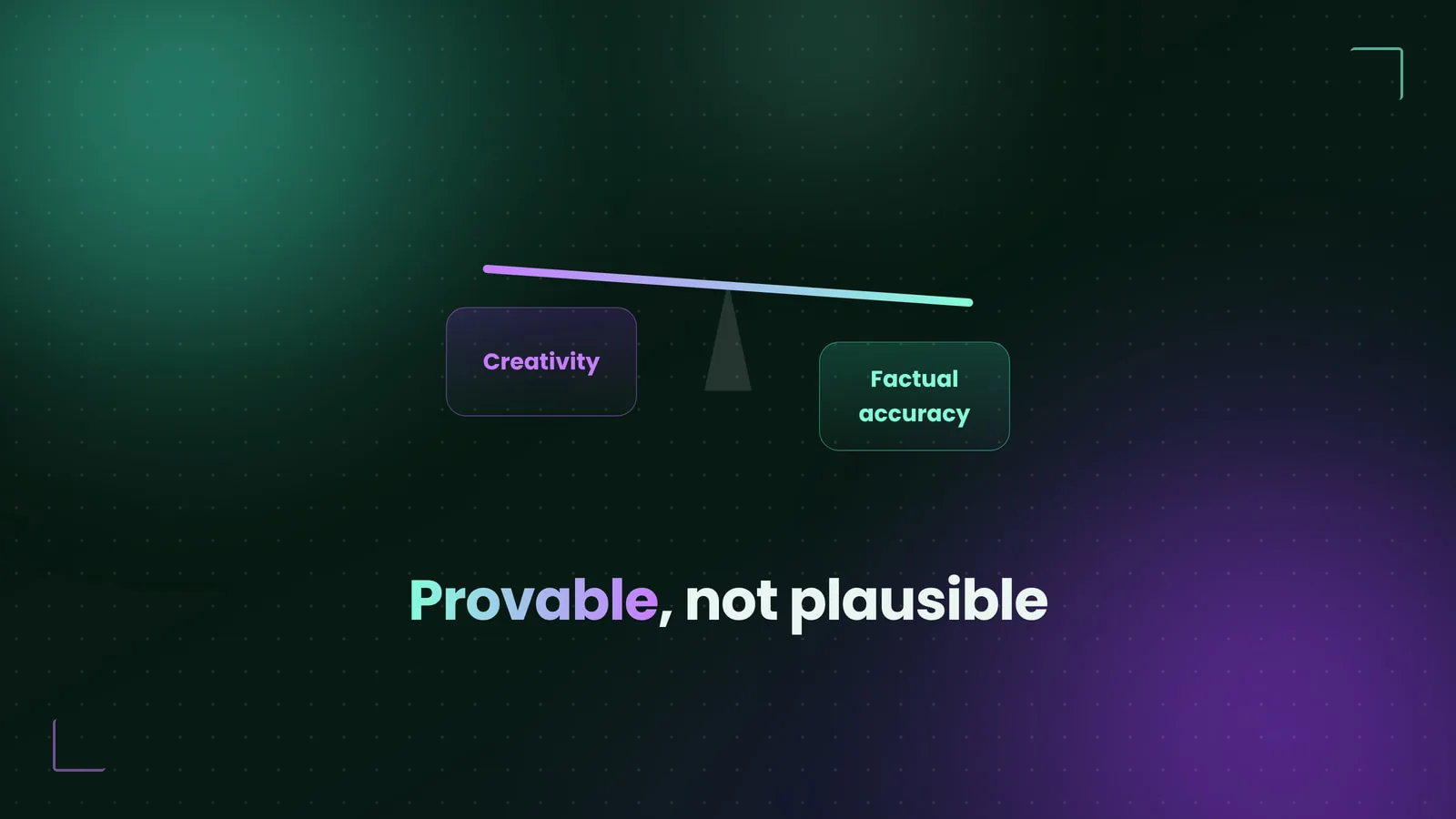

The most spectacular AI demos live on creativity. A model composes, drafts, rephrases and impresses with linguistic ease. No wonder many companies associate AI with this skill first. But in the reality of a regulated operation, a different quality counts far more, and it is decidedly less spectacular: factual accuracy.
Because when it matters, nobody asks whether an AI phrased things beautifully. The question is whether the statement is correct, where it comes from and who stands behind it. That is exactly where nice technology parts ways with trustworthy AI. How consequential the difference is becomes clear from a public tracker that documented more than 1,900 court cases with AI-generated false citations by 2026, many of them resulting in sanctions1. These are not edge cases but the price of confusing creativity with reliability.
Two yardsticks that often get confused
Creativity and factual accuracy are not opposites, but they measure entirely different things. Creativity assesses how new, fluent and convincing an answer sounds. Factual accuracy assesses how correct and provable it is.
For an advertising text, the first yardstick is king. For an audit record, a security instruction or a compliance answer, it is the second. The problem arises when companies use a tool built for creativity on tasks that demand factual accuracy. Then the answer sounds brilliant and, in the worst case, is still wrong. And that case is not rare: even on the simple task of summarizing short texts, many widely used models hallucinate in 5 to over 10 percent of cases according to the Vectara Hallucination Leaderboard2.
Trustworthy AI begins with the insight that these two yardsticks are not interchangeable. Anyone who needs reliability must not be dazzled by eloquence.
The price of a wrong answer
Why is this more than an academic distinction? Because a wrong answer in regulated contexts has real costs.
If an AI misrepresents a requirement in audit preparation, the error may travel into the documentation and only surface with the assessor. If a training system explains a security process inaccurately, employees act in an emergency on an instruction that never applied. If an assistant states an invented figure, someone makes a decision on a false basis.
In all these cases, the linguistic polish of the answer is completely irrelevant. All that counts is whether it was correct and provable. This matters all the more as regulation tightens: NIS2 affects around 160,000 entities across the EU, and fines for essential entities reach up to 10 million euros or 2 percent of global annual turnover3. In such an environment, an invented statement is not a cosmetic flaw but a risk with a price tag.
That this is no niche concern shows in McKinsey's 2026 survey: among all AI risks companies work to mitigate, inaccuracy is one of the most frequently named, with a good half citing it5. The worry about wrong answers weighs more heavily there than the worry about data privacy breaches.
Traceability is the real currency
Factual accuracy alone is not enough. A statement can be correct by chance and still be worthless if nobody can prove where it comes from. In regulated areas, traceability is therefore the real currency.
An assessor, an auditor or an internal reviewer does not just want the right answer. They want the source. They want to see which approved document a statement rests on. A system that cannot provide this creates extra work, because every piece of information has to be checked by hand.
This is where AI-THINK.'s validated conversational AI shows its strength. The AI-VI Core Technology (patent pending with the DPMA) reproduces exclusively approved content, and every answer traces back to its source. An answer thus becomes evidence. That is the difference between an AI you have to believe and an AI you can prove.
Creativity has its place, just not everywhere
None of this speaks against generative AI. It is a powerful tool for the right task. In brainstorming, a first draft, or the search for ideas under human supervision, generative freedom is a gain. There, an occasional misstep is bearable, because a human reviews and shapes the result anyway.
The mistake lies not in creativity itself but in its use in the wrong place. A compliance answer is not a brainstorm. A security instruction is not a creative draft. The moment an answer has to be binding, the yardstick shifts from creativity to factual accuracy, and the tool should shift with it.
That there is still room to improve is clear from the market: while 78 percent of companies already use AI according to the Stanford AI Index 20254, many struggle to scale reliably, because they use generative tools even where reliability would actually be required.
What trustworthy AI looks like in daily work
How do you recognize an AI system that takes factual accuracy seriously? By three traits.
It does not invent.When information is missing, the system admits the limit instead of constructing a plausible answer. Honesty about knowledge gaps is a mark of quality, not a flaw.
It provides evidence.Every answer traces back to the source. That creates the basis for audits, reviews and internal trust.
It stays under control.You decide which content is approved. When a requirement changes, you change the source, not an opaque model. That keeps the system current and steerable.
Conclusion
Creativity makes AI impressive. Factual accuracy makes it usable for everything that counts. In regulated areas, it is not the nicest phrasing that decides but the correct, provable answer.
Trustworthy AI therefore puts the origin and correctness of a statement above its linguistic shine. It does not invent, it provides evidence, and it stays under your control. For companies that carry responsibility, that is not a sacrifice but a foundation.
Want AI your assessors trust?
Discover AI-VI and experience answers you can not only believe but prove. The AI with a human touch.

Sources
- [1]Damien Charlotin: AI Hallucination Cases Database (laufend aktualisiert, Stand 2026, über 1.900 dokumentierte Fälle), gerichtlich bestätigte KI-Falschzitatehttps://www.damiencharlotin.com/hallucinations/
- [2]Vectara: Hallucination Leaderboard (Stand 2025/2026), Messung der Faktenkonsistenz beim Zusammenfassen kurzer Dokumentehttps://github.com/vectara/hallucination-leaderboard
- [3]Europäische Kommission: NIS2-Richtlinie (Directive (EU) 2022/2555), Anwendungsbereich und Sanktionsrahmen; Kennzahlen u. a. rund 160.000 betroffene Einrichtungenhttps://digital-strategy.ec.europa.eu/en/policies/nis2-directive
- [4]Stanford University, Human-Centered AI Institute (HAI): AI Index Report 2025https://hai.stanford.edu/ai-index/2025-ai-index-report
- [5]McKinsey & Company / QuantumBlack: The state of AI in 2026: On the road to ROI, August 2026. Befragung von 1.719 Teilnehmenden aus 97 Ländern, 4. Mai bis 8. Juni 2026. 89 Prozent nutzen AI regelmäßig in mindestens einem Bereich, davon haben 44 Prozent unternehmensweit skaliert, nach 38 Prozent im Vorjahr. 37 Prozent melden einen positiven EBIT-Beitrag, unverändert zum Vorjahr. 80 Prozent berichten von besserer persönlicher Produktivität. Ungenauigkeit gehört mit gut der Hälfte der Nennungen zu den meistgenannten Risiken, die aktiv gemindert werdenhttps://www.mckinsey.com/capabilities/quantumblack/our-insights/the-state-of-ai
23 July 2026 · 5 min read