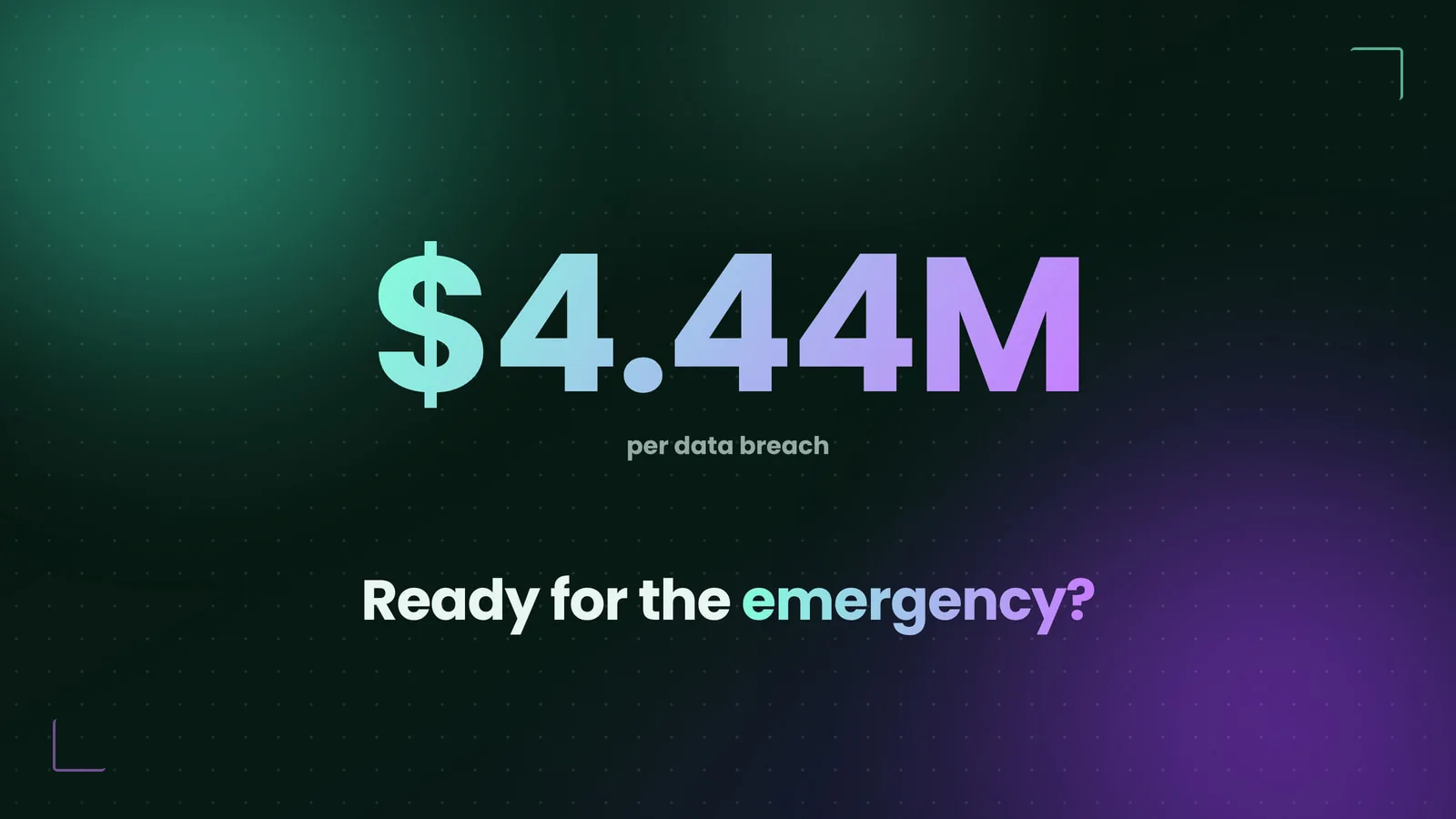

It is 11 p.m. on a Friday. A ransomware alert flashes on the screen, systems go down, the phone rings. What counts now is not the emergency plans in the folder, but the reflexes of the people who have to make decisions right now. And that is exactly where it is decided whether an incident becomes a manageable event or a catastrophe.
The numbers are sobering. According to the IBM Cost of a Data Breach Report 2025, a data breach costs 4.44 million US dollars on global average, and phishing is the most common initial attack vector at 16 percent, with 4.8 million US dollars in average damage1. The weak point is almost always the human. So that is exactly where you have to start.
Why classic training falls short
The usual answer to this risk is a training session: a presentation, a few slides, a short test at the end. That conveys knowledge, no question. But knowledge is not the same as the ability to act.
In a real emergency, there is stress, time pressure and uncertainty. Under these conditions, nobody falls back on a slide they saw months ago. They fall back on practised reflexes. And reflexes arise not from listening but from experiencing. It is exactly this gap between knowing and doing that classic training leaves open.
What a crisis simulation does differently
A crisis simulation reverses the principle. Instead of talking about an incident, it lets people experience it. Employees stand in the middle of the scenario, make decisions and see their consequences immediately. The pressure is real enough to challenge, but the environment is safe, because nothing real is at stake.
This difference is decisive. Anyone who has played through a security incident once reacts faster, calmer and more correctly in the real case. Abstract knowledge becomes a trained sequence. And because mistakes in the simulation cost nothing, they are the most valuable part of the whole training, because you learn the most from them.
The role of AI avatars
This is where AI avatars come in. They turn a static exercise into a living scenario. An avatar can play a role, the caller, the attacker, the nervous colleague, and react dynamically to the participants' decisions. The scenario is not on rails but adapts.
AI-THINK.'s AI-VI Cybersecurity Coach uses exactly this principle. Employees live through realistic incidents in which an avatar steers the situation, escalations and twists. The result is training that challenges without overwhelming and can be repeated as often as needed until the reaction sticks.
The foundation is decisive here. Because the Coach rests on the validated AI-VI Core Technology (patent pending with the DPMA), every technical explanation in the training is reviewed and traceable to the source. The team therefore learns not some plausible-sounding half-knowledge, but what really applies in your company. Delivered in more than 70 languages, the same training reaches all sites consistently.
From leaflet to muscle memory
The real gain of a crisis simulation is a shift in mindset. Employees who know an incident in theory become employees who have already mastered it once. In the decisive moment, that experience is worth more than any manual.
This is especially true for the human attack routes the statistics make so clear. Phishing, social engineering and, increasingly, deepfakes target not technology but people. A team that has played through these tricks in a safe space is the most effective line of defence a company can build.
Conclusion
In a security incident, reflexes count, not leaflets. And reflexes only arise through practice. Classic training conveys knowledge, but it rarely closes the gap to actual action.
A crisis simulation with AI avatars closes exactly this gap. It lets employees experience the emergency safely, again and again, until the right reaction sticks. Given millions in damage per incident, that is not a nice add-on but one of the best investments in your company's resilience.
Want to make your team ready for the emergency?
Get to know the AI-VI Cybersecurity Coach and let your people rehearse the emergency before it happens. The AI with a human touch.

Sources
- [1]IBM Security: Cost of a Data Breach Report 2025, globaler Durchschnitt 4,44 Mio. US-Dollar pro Vorfall; Phishing häufigster erster Angriffsweg (16 Prozent) mit durchschnittlich 4,8 Mio. US-Dollar Schadenhttps://www.ibm.com/reports/data-breach
16 July 2026 · 3 min read