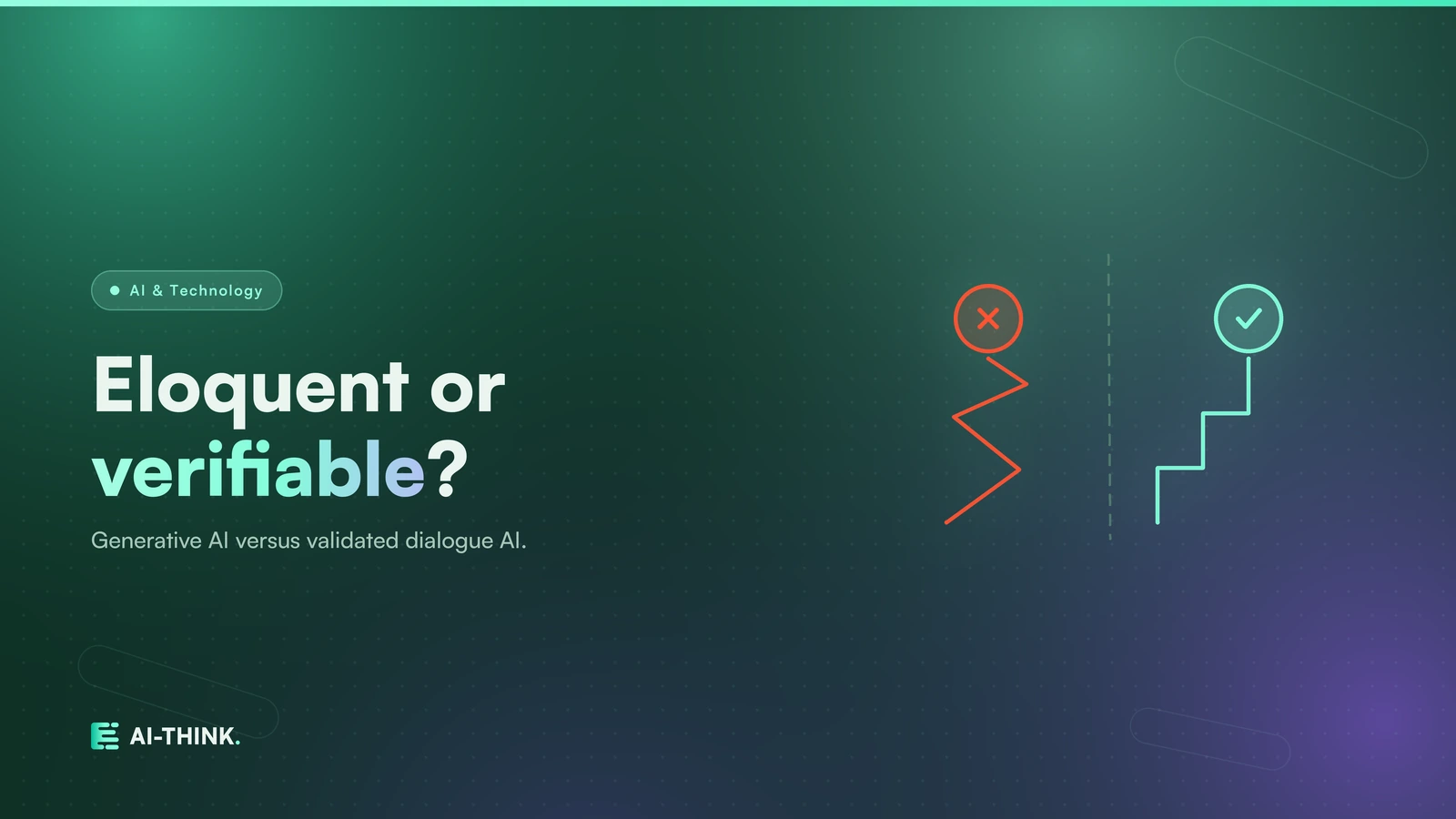

Picture two employees. One is eloquent, answers every question instantly and sounds convincing. The trouble is, nobody knows exactly where the knowledge comes from, and every now and then this person invents details that never existed. The other answers just as quickly, but every statement traces back to an approved document. When this person does not know something, they say so.
Which of the two would you trust with an ISO 27001 audit?
That picture captures the difference between generative AI and validated conversational AI. At first glance they look identical. In practice, worlds separate them the moment traceability, compliance and liability come into play. And this is no longer a niche topic: according to the Stanford AI Index 2025, 78 percent of organizations used artificial intelligence in 2024, and 71 percent already used generative AI1. The question is no longer whether AI arrives, but which kind.
What generative AI actually does
Large language models like the ones behind ChatGPT are impressive machines. Their core task, however, is more sober than many assume: they predict the most likely next word. Trained on enormous amounts of text, they produce fluent, plausible language. That is their strength and, at the same time, their risk.
A generative model knows no difference between true and plausible. It optimizes for sound, not for facts. When information is missing, it fills the gap with something that seems statistically fitting. Experts call this hallucination, and it is measurable. Even on the relatively simple task of summarizing short texts, the best models produce roughly 1.8 to 3 percent invented statements according to the Vectara Hallucination Leaderboard, while many widely used models land at 5 to over 10 percent2. For a marketing text that is rarely a problem. In a regulated setting, a single invented figure can get expensive.
Just how expensive is visible in the courts. A public tracker counted more than 1,900 court cases by 2026 in which filings contained invented, AI-generated citations, some resulting in sanctions for the lawyers involved3. If even legal professionals fall for plausible-sounding fabrications, it should be clear how careful you have to be in auditing, compliance and expert advice.
There is a second issue: provenance. A generative model blends its training knowledge with your input and produces a new answer from it. Which source shaped which part of the answer can hardly be cleanly proven afterwards. For creative work that does not matter. For an audit trail, it is a dealbreaker.
What validated conversational AI does differently
Validated conversational AI reverses the principle. It does not invent answers, it delivers approved ones. The basis is not an anonymous ocean of training data, but your own, reviewed knowledge: policies, process descriptions, audit reports, technical documents.
At AI-THINK., the AI-VI Core Technology (patent pending with the DPMA) forms the foundation. Content is structured, professionally reviewed, approved and only then delivered as an interactive video dialogue. When the avatar answers, it draws exclusively on that approved body of knowledge. It adds nothing that was not signed off beforehand.
The effect is fundamental. Every statement traces back to a source document. There is no grey area between model knowledge and company knowledge, because model knowledge does not serve as an answer source at all. And when no approved information exists for a question, the system invents nothing and transparently says so.
The comparison that matters
It is worth measuring both approaches against the criteria that count in daily business.
Factual accuracy.Generative AI can hallucinate because it optimizes for probability. Validated conversational AI structurally cannot, because its answer space is limited to approved content.
Traceability.With generative AI, the origin of a statement usually stays unclear. With validated conversational AI, every answer leads back to the source, ideal for audits, reviews and internal control.
Control.A generative model updates its behaviour with every new training version, often without you steering it. With validated conversational AI, you decide which content is approved. When a policy changes, you change the source, not an opaque model.
Scaling without loss of quality.One approved piece of content can be delivered in more than 70 languages with a single professional sign-off. You review once and deliver consistently worldwide.
Acceptance.A video avatar that explains calmly and clearly noticeably lowers the barrier to asking. That is exactly what the AI-THINK. guiding idea means: the AI with a human touch. Technology that feels human rather than like an anonymous chat window.
When each approach fits
The honest answer: it depends on the purpose. Generative AI is strong when creativity, variety of ideas and speed of phrasing count, for example in brainstorming, a first draft, or research under human supervision.
Validated conversational AI is superior the moment reliability is required. In audit preparation, compliance training, or knowledge transfer about reviewed processes, anywhere a wrong statement has real consequences, a system that only reproduces approved content is not the cautious choice but the professional one.
Many companies combine both. They use generative tools for creative groundwork and validated conversational AI wherever an answer has to hold up. That also matches the market's maturity: McKinsey reports broad use, yet not even half of the companies using AI have scaled it across the enterprise4.
Why the difference is strategic
Regulation like NIS2 and DORA increases the pressure to make processes provable. At the same time, the wish grows to keep knowledge scalable and understandable. A generative model alone does not resolve this tension, because it offers speed but no reliable provenance.
Validated conversational AI closes exactly that gap. It combines the accessibility of modern AI with the reliability of a reviewed document. That is not a compromise but a category of its own: fast like a chat, reliable like a sign-off.
Conclusion
Generative AI impresses through language. Validated conversational AI convinces through reliability. For creative tasks, the first is indispensable. For everything that must be reviewed, proven and defended, there is no way around the second.
If your company wants to provide knowledge that is always available, consistent across many languages and still traceable to the source, then validated conversational AI deserves a close look.
Want to see what that looks like in practice?
Get to know AI-VI and experience how approved expertise turns into an interactive, multilingual dialogue. The AI with a human touch.

Sources
- [1]Stanford University, Human-Centered AI Institute (HAI): AI Index Report 2025https://hai.stanford.edu/ai-index/2025-ai-index-report
- [2]Vectara: Hallucination Leaderboard (Stand 2025/2026), Messung der Faktenkonsistenz beim Zusammenfassen von Dokumenten mit dem HHEM-Modellhttps://github.com/vectara/hallucination-leaderboard
- [3]Damien Charlotin: AI Hallucination Cases Database (laufend aktualisiert, Stand 2026, über 1.900 dokumentierte Fälle), gerichtlich bestätigte KI-Falschzitatehttps://www.damiencharlotin.com/hallucinations/
- [4]McKinsey & Company / QuantumBlack: The state of AI in 2026: On the road to ROI, August 2026. Befragung von 1.719 Teilnehmenden aus 97 Ländern, 4. Mai bis 8. Juni 2026. 89 Prozent nutzen AI regelmäßig in mindestens einem Bereich, davon haben 44 Prozent unternehmensweit skaliert, nach 38 Prozent im Vorjahrhttps://www.mckinsey.com/capabilities/quantumblack/our-insights/the-state-of-ai
18 September 2026 · 5 min read