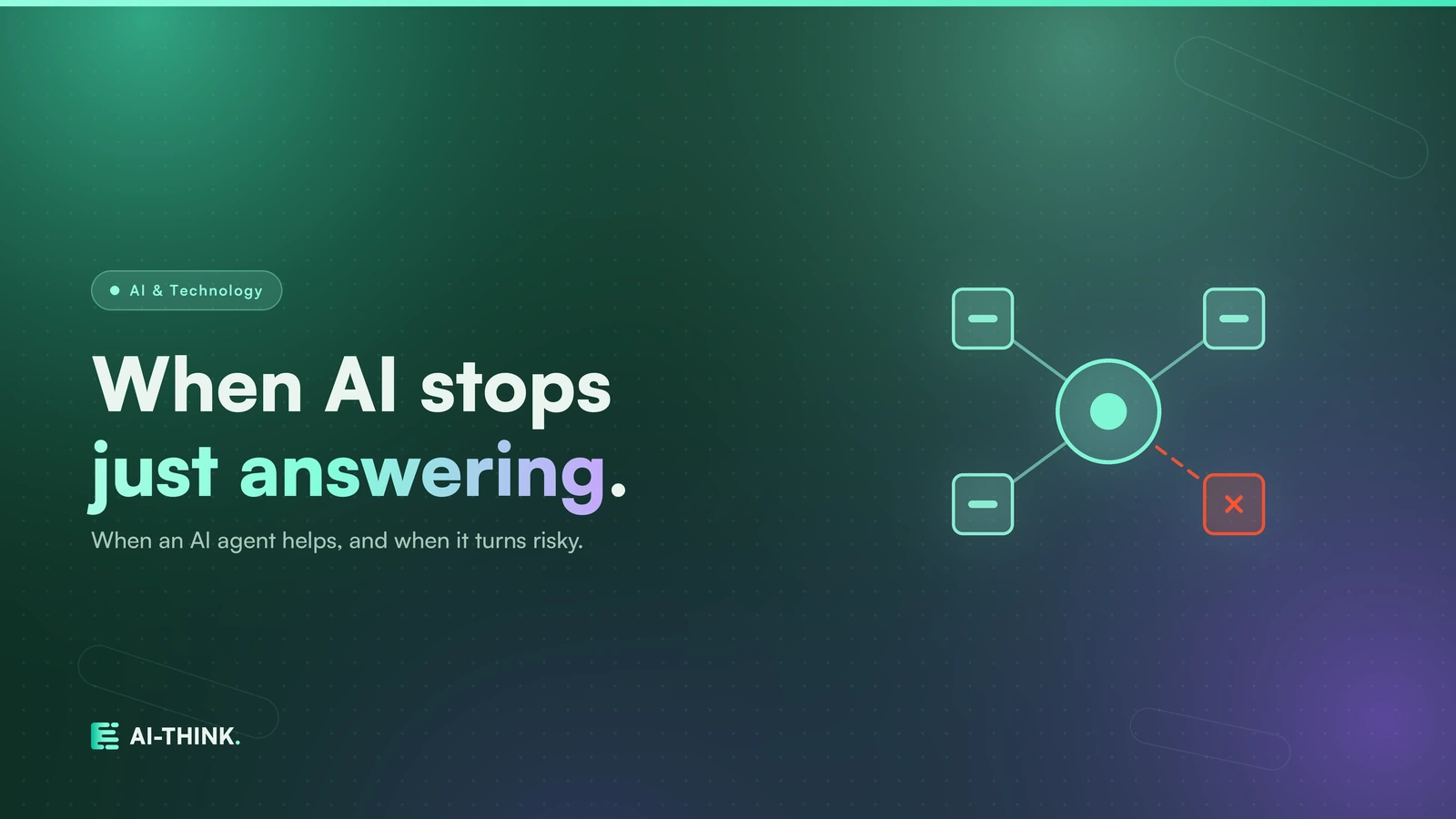

Hardly any term drew as much attention in 2026 as agentic AI. Instead of just answering, an AI agent is meant to act on its own: plan tasks, operate tools, make decisions, set things in motion. That sounds like the next big step, and in many cases it is.
But the euphoria has a flip side. Gartner expects more than 40 percent of agentic AI projects to be cancelled by the end of 2027, among other reasons because of rising costs, unclear value and inadequate risk control1. High time to separate things soberly: when does an agent really help, and when does it become a risk?
What sets an AI agent apart from an assistant
A classic AI assistant answers. You ask, it delivers information, you decide. An AI agent goes further: it is allowed to act. It calls interfaces, triggers follow-up actions, works through steps on its own until a goal is reached.
That is exactly where the appeal and the danger lie. An assistant that errs gives a wrong piece of information. An agent that errs performs a wrong action, perhaps sends a message, changes a record or kicks off a process. The mistake does not stay in the chat window but travels into the real world.
Why so many agent projects fail
Gartner also warns of "agent washing": many offerings carry the agent label without real autonomous capabilities1. Often a dressed-up chatbot hides behind it. That explains part of the disappointment.
The other part is more fundamental. An agent multiplies the impact of every answer. If even a single statement can be wrong, then a whole chain of autonomous actions is all the more risky. Without clear boundaries, clean permissions and traceable decisions, the surface for errors grows with every step. Where the value stays unclear and the costs rise, the project ends up being stopped.
When an agent pays off
That does not mean agentic AI is a dead end. It pays off where three conditions come together: the task is clearly scoped, the possible actions are tightly limited, and every step is reversible or approved by a human.
In such fields, an agent can relieve enormous load, for example in sorting, preparing and passing on routine cases. What matters is that the human keeps control, not as a brake but as a safety net. That is exactly why Gartner stresses that human oversight stays indispensable for the foreseeable future.
First the reliable knowledge base, then the autonomy
A change of perspective helps here. Before an AI is allowed to act on its own, it should be clear that it reliably knows the right thing at all. An agent built on a shaky, hallucinating knowledge base only multiplies the errors.
AI-THINK.'s approach therefore starts one stage earlier. The AI-VI Core Technology (patent pending with the DPMA) delivers answers exclusively from approved, reviewed content, traceable to the source. That is the solid foundation on which responsible automation can be built in the first place. Anyone with the knowledge base under control can hand over more scope for action step by step, without losing control.
Conclusion
Agentic AI is powerful because it acts. It is risky for exactly the same reason. The high cancellation rate Gartner expects is not an argument against agents, but against their careless use.
Start with tightly scoped tasks, keep the human in the loop and first ensure a reliable, provable knowledge base. Autonomy is not a starting point, but the result of trust you earn step by step.
Want AI that reliably knows the right thing first?
Get to know AI-VI and build on a foundation you can trust. The AI with a human touch.

Sources
- [1]abGartner: Gartner Predicts Over 40% of Agentic AI Projects Will Be Canceled by End of 2027 (Pressemitteilung, 25. Juni 2025), u. a. wegen steigender Kosten, unklarem Geschäftswert und unzureichender Risikokontrolle; Warnung vor „Agent Washing"https://www.gartner.com/en/newsroom/press-releases/2025-06-25-gartner-predicts-over-40-percent-of-agentic-ai-projects-will-be-canceled-by-end-of-2027
28 May 2026 · 3 min read