
Every impressive AI answer has an invisible backstory. With generative systems, that backstory lies in a gigantic, anonymous training run. With validated conversational AI, it lies in your own house, in your documents, your processes, your reviewed knowledge. The exciting question is: how does that become a system you can actually deploy?
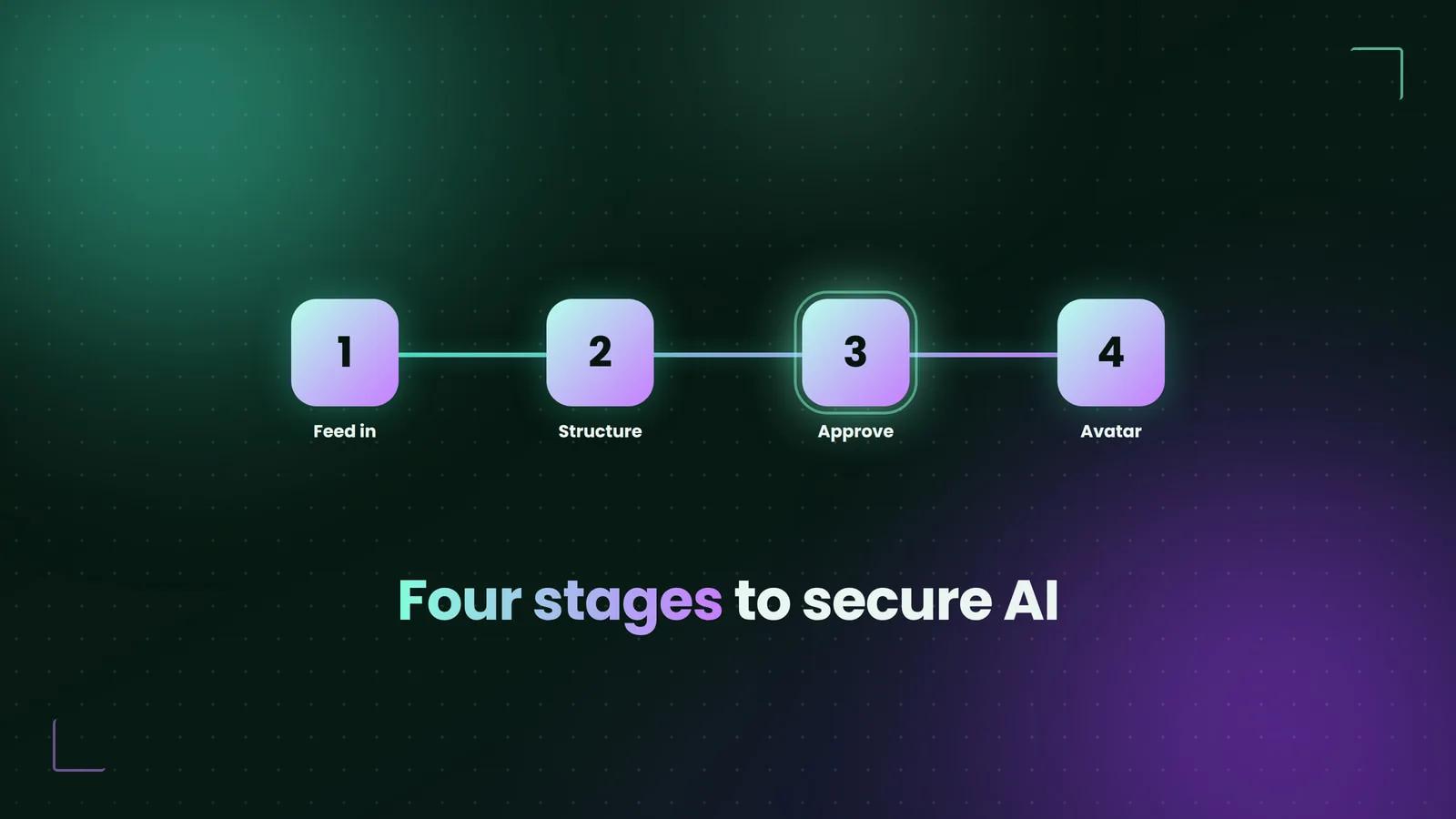
This question is anything but academic. According to McKinsey, nearly nine in ten companies use AI regularly in at least one function, but only 44 percent of them have scaled it across the enterprise1. A gap remains between trying it out and relying on it. At AI-THINK., the AI-VI Core Technology (patent pending with the DPMA) answers exactly this question with a clear, four-stage path. Let us take a look behind the scenes and see how scattered company knowledge becomes a secure, approachable AI.
Why the path matters as much as the result
Before we dive into the individual stages, a word on the principle. The value of an enterprise AI does not depend on how fluently it sounds, but on what its answers rest on. That is exactly why the creation process is not a technical add-on but the heart of the matter.
A clean process ensures that in the end only reviewed, approved knowledge is in circulation. It is the reason the finished system does not hallucinate, why every answer traces back to the source, and why specialist departments can trust the result. That this point is decisive is shown by the benchmark for generative models: even on the mere task of summarizing short, supplied texts, many widely used models produce 5 to over 10 percent invented statements according to the Vectara Hallucination Leaderboard2. The four stages are therefore less an assembly line than a chain of quality checks.
Stage 1: feed in the content
Everything begins with your knowledge. In the first stage, the relevant sources flow into the system: policies, process descriptions, audit reports, manuals, technical documents. The raw material already exists, it is just often scattered, in different formats and in many places.
What matters in this phase is that the basis comes from your house and not from an anonymous ocean of training data. The AI is not fed with foreign knowledge that would later be hard to separate from yours. It is fed with exactly what applies in your company. From the outset, it is clear whose knowledge will later speak.
Stage 2: structure and shape dialogues
Raw documents are not yet dialogues. In the second stage, static text becomes a conversation. The content is structured, divided into meaningful units and translated into question-and-answer relationships. A chapter about a security process thus becomes a dialogue that responds to the users' actual questions.
This step is more than formatting. It determines how natural the later conversation feels and whether the right answers fit the right questions. Knowledge is not just rearranged here but made usable for dialogue, without changing its professional core.
Stage 3: review and approve
Now comes the stage that makes the decisive difference from generative AI. Before any content becomes visible to users, it goes through a professional review and approval. Those responsible check whether the prepared dialogues are correct, complete and in the company's interest.
Only what is signed off here may later be said by the avatar. This approval step is the reason the system cannot invent. There is no path by which unreviewed content ends up in an answer. Approval thus turns from a tedious formality into the central safety promise of the entire architecture.
A pleasant side effect: because approval happens at the level of the content, it then applies to all languages. One approved dialogue can be delivered in more than 70 languages without having to sign off each translation again.
Stage 4: deliver as an avatar
In the final stage, reviewed knowledge becomes a counterpart. The approved content is delivered as an interactive video dialogue, presented by an AI avatar that explains calmly and clearly. A document nobody reads becomes a point of contact you simply ask.
Here all the previous effort pays off. The user experiences a fluid, human-feeling interaction, while in the background there is the certainty that every statement is reviewed and traceable. That interplay of accessibility and reliability is exactly what the AI-THINK. guiding idea means: the AI with a human touch.
What the process means for your company
At first glance, a four-stage path seems more elaborate than quickly filling a generic chatbot. That impression is misleading. The effort occurs once and in the right place, namely in quality assurance. In return, the constant doubt about whether an answer is correct disappears later.
You review once and deliver consistently for the long term. When a requirement changes, you update the source and the approval, not an opaque model. That keeps the system current, steerable and auditable at any time. It is exactly this steerability where many generic AI projects fail, while a clearly managed approval process delivers it from the start. Company knowledge thus becomes not a risky experiment but a robust infrastructure.
Conclusion
Company knowledge becomes a secure AI when the path to it is right. The four-stage process of feeding in, structuring, approving and delivering ensures that in the end only reviewed knowledge speaks.
Approval in the third stage is the key. It is the reason the finished system does not hallucinate, why it stays consistent across languages, and why every answer traces back to the source. Not chance, but architecture.
Want to know how your knowledge turns into a dialogue?
Get to know AI-VI and see how your documents become an AI you can trust. The AI with a human touch.

Sources
- [1]McKinsey & Company / QuantumBlack: The state of AI in 2026: On the road to ROI, August 2026. Befragung von 1.719 Teilnehmenden aus 97 Ländern, 4. Mai bis 8. Juni 2026. 89 Prozent nutzen AI regelmäßig in mindestens einem Bereich, davon haben 44 Prozent unternehmensweit skaliert, nach 38 Prozent im Vorjahrhttps://www.mckinsey.com/capabilities/quantumblack/our-insights/the-state-of-ai
- [2]Vectara: Hallucination Leaderboard (Stand 2025/2026), Messung der Faktenkonsistenz beim Zusammenfassen kurzer Dokumentehttps://github.com/vectara/hallucination-leaderboard
20 August 2026 · 5 min read