
With AI, a lot is said about technology and little about what counts in the end: does the whole thing pay off? The question is justified, because the disillusionment is real. A widely noted MIT study found in 2025 that 95 percent of AI pilot projects deliver no measurable impact on business results1. McKinsey describes the same gap from another angle in 2026: 80 percent of respondents say AI has improved their personal productivity, yet only 37 percent see a positive earnings contribution at the company level, unchanged from the previous year3. The benefit arises with the individual, it just does not reach the books. Anyone who invests does not want to land in this majority.
So let us calculate soberly. Where exactly does the return arise with an AI avatar, and how do you make it visible? Three levers are decisive: time, costs and scaling.
Lever 1: time that seeps away in searching today
The biggest hidden cost block in knowledge management is time. Employees search for answers in manuals, wait for a response from colleagues or ask the same question yet again. These minutes add up, across many people and many days, to a considerable amount.
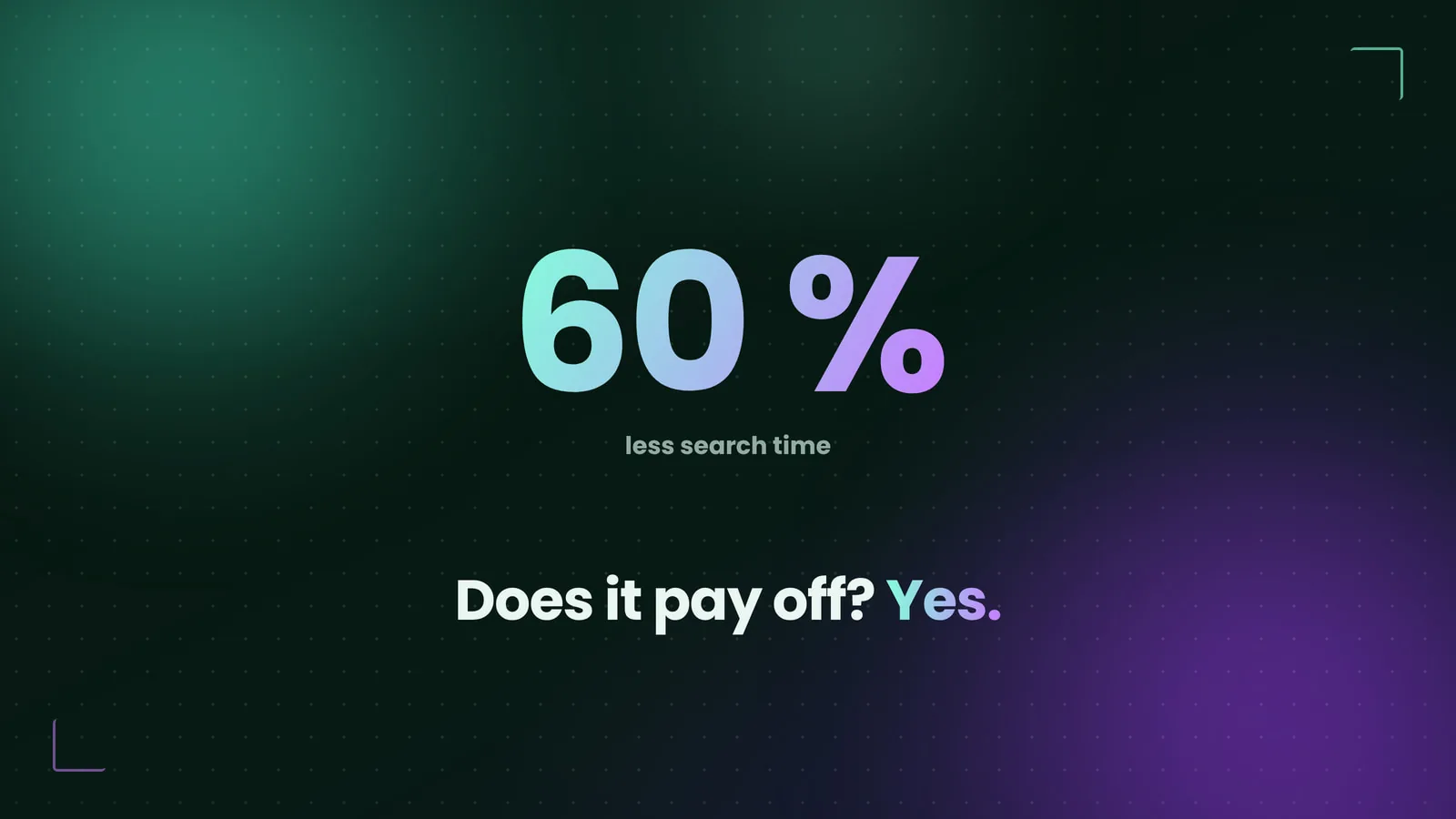
An AI avatar that provides reviewed knowledge instantly and understandably targets exactly this. Instead of searching, you ask. According to AI-THINK., its use reduces the time bound up in such processes by up to 60 percent2. Scale that up to a team, and an abstract percentage becomes a very concrete value in working hours.
Lever 2: costs you bear once instead of again and again
The second lever is the structure of the costs. Classic knowledge transfer ties up expensive experts in recurring tasks: answering the same questions, giving the same training, explaining the same documents. These costs come up again and again.
An avatar reverses that. The effort arises once, in preparing and approving the content. After that, the knowledge is available any number of times without an expert being tied up each time. AI-THINK. puts the possible cost reduction at up to 50 percent2. The core behind it is simple: you pay for the preparation once and reap it permanently.
Lever 3: scaling without proportional costs
The third lever is the one most easily underestimated. With human knowledge transfer, costs rise with every additional site, every language, every new employee. Twice as many requests mean roughly twice as much effort.
With a validated avatar it is different. One approved piece of content can be delivered in more than 70 languages with a single professional sign-off2. Whether ten or a thousand people ask, whether at one site or twenty, the marginal cost of an additional answer is minimal. It is exactly this decoupling of usage and cost that is the real economic appeal.
A simple calculation example
Let us make it tangible. Assume 100 employees spend on average 30 minutes a day searching for information and asking internal questions. That is 50 working hours a day seeping away in searching.
If an avatar reduces this effort by just the mentioned 60 percent, 30 hours are freed up daily, the capacity of almost four full-time employees, day after day. Even if you calculate conservatively and halve the figures, an effect remains that catches up with the investment quickly. That is exactly how you turn a gut feeling into a solid basis for decisions.
Why reliability is the precondition for ROI
An important caveat belongs here: the whole calculation only works if the answers are correct. An avatar that hallucinates creates not value but new risks and new rework. That is exactly why reliability is not a side aspect but the basic condition for any ROI.
AI-THINK.'s AI-VI Core Technology (patent pending with the DPMA) answers exclusively from approved, reviewed content, traceable to the source. That is the reason the time saving is real and not eaten up again by control effort. The return arises not despite but because of the built-in reliability.
Conclusion
The ROI of an AI avatar arises in three places: in the time that no longer seeps away in searching, in the costs that come up once instead of recurring, and in the scaling that causes hardly any additional cost.
Anyone who calculates these levers with their own numbers quickly leaves the realm of guesswork. The precondition for that is an AI whose answers you can really trust. Only then does potential become a measurable gain.
Want to calculate the ROI for your company?
Get to know AI-VI and see how reviewed knowledge noticeably reduces time, costs and effort. The AI with a human touch.

Sources
- [1]MIT NANDA / MIT Media Lab: The State of AI in Business 2025 (August 2025), 95 Prozent der Gen-AI-Pilotprojekte ohne messbaren Effekt auf das Geschäftsergebnishttps://mlq.ai/media/quarterly_decks/v0.1_State_of_AI_in_Business_2025_Report.pdf
- [2]abcAI-THINK. / AI-VI: Herstellerangaben zu bis zu 60 Prozent Zeitersparnis, bis zu 50 Prozent Kostensenkung und über 70 Sprachen mit einer einzigen Freigabehttps://ai-think.de
- [3]McKinsey & Company / QuantumBlack: The state of AI in 2026: On the road to ROI, August 2026. Befragung von 1.719 Teilnehmenden aus 97 Ländern, 4. Mai bis 8. Juni 2026. 89 Prozent nutzen AI regelmäßig in mindestens einem Bereich, davon haben 44 Prozent unternehmensweit skaliert, nach 38 Prozent im Vorjahr. 37 Prozent melden einen positiven EBIT-Beitrag, unverändert zum Vorjahr. 80 Prozent berichten von besserer persönlicher Produktivität. Ungenauigkeit gehört mit gut der Hälfte der Nennungen zu den meistgenannten Risiken, die aktiv gemindert werdenhttps://www.mckinsey.com/capabilities/quantumblack/our-insights/the-state-of-ai
13 August 2026 · 4 min read