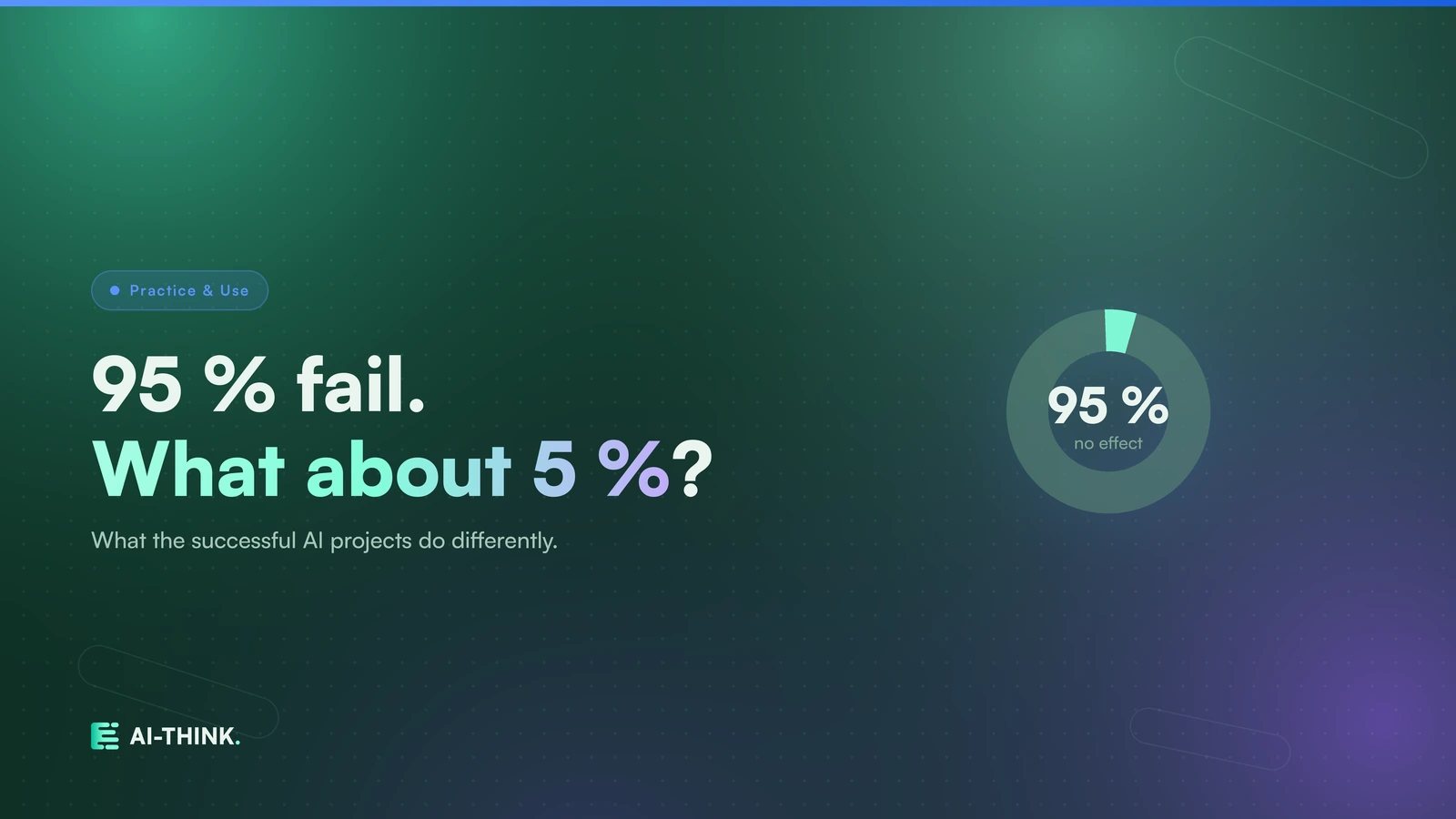

It is the number that swept through every boardroom in 2025: 95 percent. According to a widely noted MIT study, that is the share of corporate AI pilot projects that deliver no measurable impact on business results1. It is not that 5 percent fail; it is that 95 percent stay without effect. For a topic soaking up billions right now, that is an uncomfortable truth.
The good news: the failure follows a pattern. And the small group that succeeds does a few things consistently differently. Let us look at where the 95 percent get stuck and what you can learn from it.
The pilot impresses, production disappoints
MIT calls it the GenAI Divide: the gap between an impressive demo and a system that actually holds up in daily work1. Almost any company today can build a prototype in a few days that wows a meeting. The leap from there into reliable, productive operation succeeds for only a few.
The reason is rarely the technology itself. Models are powerful and easy to access. It is the surrounding conditions that break: unclear ownership, poor data quality, no clean process and, above all, no dependable result the specialist department trusts.
The four most common breaking points
In practice you meet the same four patterns again and again.
No clear problem.Many projects start with the technology, not the task. "We have to do something with AI" is not a goal. Without a concrete, measurable use case, there is no yardstick for success.
Reliability is missing.A system that sometimes answers correctly and sometimes makes things up will not be used when it matters. The moment a wrong answer has consequences, the experts lose trust and return to their old ways.
No process for upkeep and approval.Knowledge ages. Anyone without a clear way to update and approve content soon runs a system that slowly drifts.
Island solution instead of integration.A tool nobody can weave into their daily work stays unused. MIT confirms this too: success depends less on the model than on whether the system fits real workflows1.
What the 5 percent do differently
The successful projects share a mindset: they treat AI not as a magic trick but as infrastructure that has to work reliably.
First they start with a real, tightly scoped problem with clear value, not with the technology.
Second they rely on results you can trust, because they are traceable and provable.
Third they build operations in from the start, meaning upkeep, approval and ownership.
And fourth they honestly measure whether the effort pays off.
That this maturity is still rare also shows in scaling: according to McKinsey, nearly nine in ten companies use AI regularly, but only 44 percent of them have rolled it out across the enterprise2. The gap is even clearer on returns: the share of companies reporting any positive earnings contribution from AI stands at 37 percent, unchanged from the previous year, even though scaling rose from 38 to 44 percent over the same period2. More deployment alone does not produce a return. The bottleneck is almost never the model, but the reliability and the process around it.
Why validated content bridges the divide
At exactly the biggest breaking point, the missing trust, AI-THINK.'s approach comes in. The AI-VI Core Technology (patent pending with the DPMA) answers exclusively from approved, reviewed content. There is no free phrasing step that could go off the rails, and every answer traces back to the source.
That removes two of the four most common causes from the outset. Reliability is built in, because the system only reproduces approved content. And the approval process is part of the architecture, not an afterthought. What remains is your actual job: choosing the right problem and measuring the value.
Conclusion
95 percent sounds like a reason to be cautious. In truth it is a signpost. The projects rarely fail on technology, but on missing reliability, unclear goals and no process.
Anyone who takes these points seriously lands in the small group that draws real value from AI. A system that gives only provable answers and brings the approval process with it is not a luxury for that, but half the battle.
What you can do now
Start with a tightly scoped problem with clear value, not with the technology.
Settle who maintains the content and who approves it before you start.
Define upfront how you will measure success, then measure honestly.
And if you need a reviewed basis for that: Get to know AI-VI
Sources
- [1]abcMIT NANDA / MIT Media Lab: The State of AI in Business 2025: The GenAI Divide (August 2025), 95 Prozent der untersuchten Gen-AI-Pilotprojekte ohne messbaren P&L-Effekthttps://mlq.ai/media/quarterly_decks/v0.1_State_of_AI_in_Business_2025_Report.pdf
- [2]abMcKinsey & Company / QuantumBlack: The state of AI in 2026: On the road to ROI, August 2026. Befragung von 1.719 Teilnehmenden aus 97 Ländern, 4. Mai bis 8. Juni 2026. 89 Prozent nutzen AI regelmäßig in mindestens einem Bereich, davon haben 44 Prozent unternehmensweit skaliert, nach 38 Prozent im Vorjahrhttps://www.mckinsey.com/capabilities/quantumblack/our-insights/the-state-of-ai
9 April 2026 · 4 min read